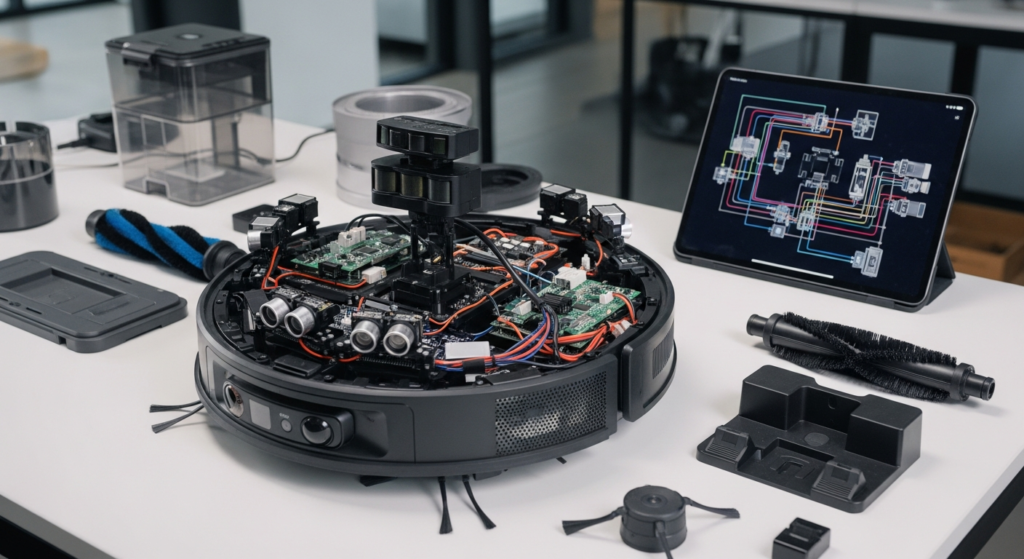
The first robot vacuum I owned was a dumb disc that played a game of pinball with my furniture. It followed a simple script: drive, bump, turn, repeat. Today, manufacturers are throwing around terms like “AI” and “Neural Processing,” promising a future where robots don’t just clean, but understand your home. This is a hardware audit of modern robot vacuum object avoidance systems. My goal is to cut through the marketing, pop the hood, and answer the fundamental questions: Does it actually think, or is it just a better script? And more importantly, is the processing happening on my local network or in some company’s cloud?
The Brain Check: From Bumpers to On-Device AI
The evolution of robot vacuums is a story of sensor fusion. Early models were functionally blind, relying on mechanical bumpers and basic infrared (IR) cliff sensors. The first major leap was vSLAM (Visual Simultaneous Localization and Mapping), which used a camera to build a crude map. It was an improvement, but it struggled in low light and was easily confused by changes in the environment.
The current gold standard is LiDAR (Light Detection and Ranging). By spinning a laser 360 degrees, these robots build a precise, millimeter-accurate map of your home, day or night. This is why modern robots can navigate so efficiently and allow for virtual “no-go” zones in an app.
But LiDAR alone isn’t “intelligence.” It sees walls and furniture legs as solid objects, but it can’t differentiate a sock from a shadow or a power cord from a pattern on the rug. This is where the new battleground lies: vision-based object avoidance. This is the “AI” you’re paying for.
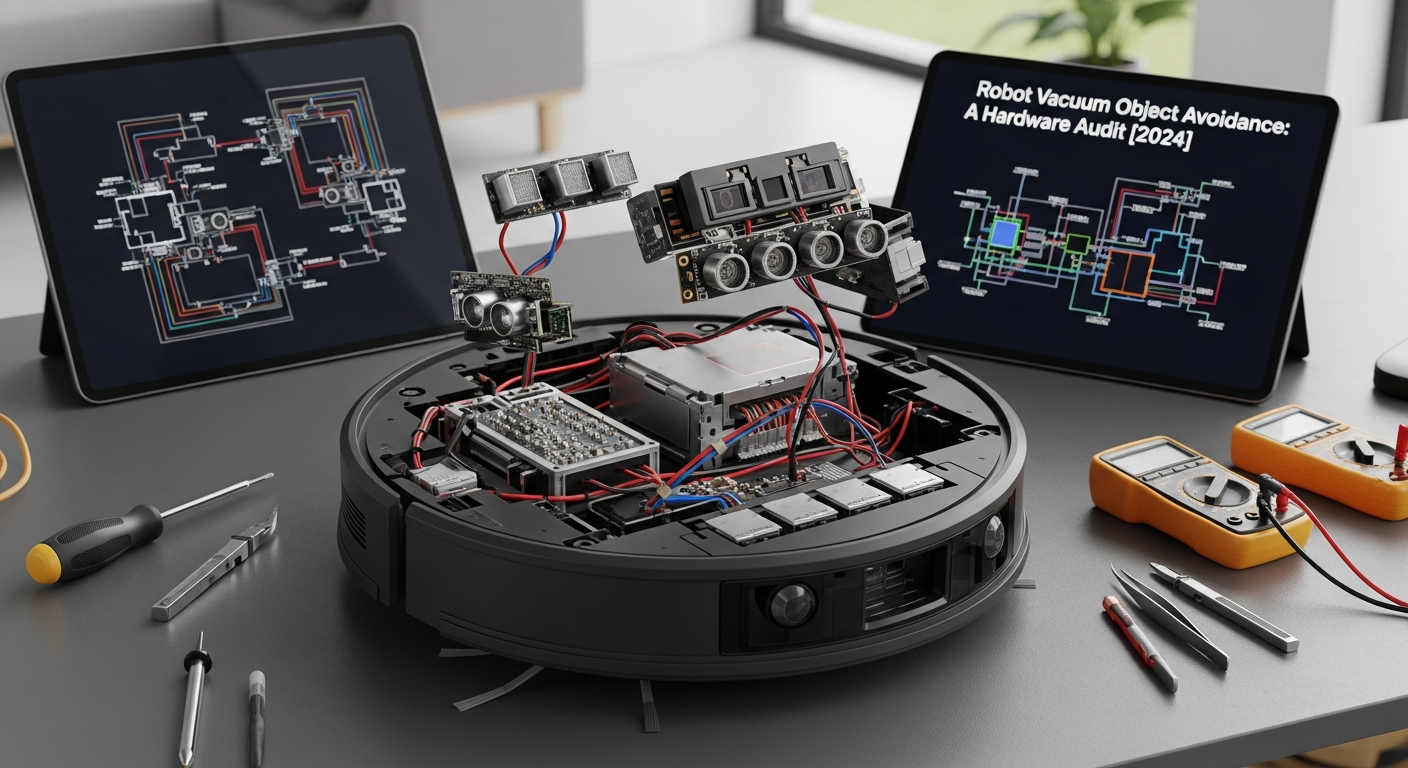
Hardware Teardown: What’s Inside the Flagships?
Let’s get to the specs. I’ve audited the top-tier models from Roborock and Dreame, with a popular Shark model as a baseline to show what a sub-$300 unit gets you. The price gap is enormous, and it’s almost entirely down to the sensor suite, the docking station’s complexity, and the on-device processing power.
| Feature | Roborock S8 MaxV Ultra | Dreame L20 Ultra | Shark AI Ultra 2-in-1 | My Systems Integrator Analysis |
|---|---|---|---|---|
| Price (MSRP) | ~$1,799 | ~$1,699 | ~$299 | A massive price delta. The premium is for advanced object avoidance, mopping automation, and edge-cleaning mechanics. The Shark is a LiDAR navigator with a bin, but it’s a generation behind in “thinking.” |
| Primary Navigation | LiDAR | LiDAR | LiDAR | Verdict: Solved Problem. LiDAR is now the commoditized standard for reliable room mapping. Don’t buy a robot without it in 2024. |
| Object Avoidance | Reactive AI 2.0: RGB Camera + 3D Structured Light | Pathfinder: RGB Camera + 3D Structured Light | Basic IR/Bumper | Verdict: The Key Differentiator. This is the “brain.” The combination of a standard camera (RGB) for recognition and structured light for depth perception allows the robot to identify and avoid small, troublesome objects like cables, shoes, and the dreaded pet waste. This processing happens on-device, a huge win for privacy and speed. The Shark’s system is primitive by comparison; it will get stuck on cables. |
| On-Device Compute | “Hello Rocky” voice assistant implies a dedicated NPU/SoC. | Vision data processed locally for navigation. | Basic pathing MCU. | Verdict: A Glimpse of the Future. The presence of a local voice assistant on the Roborock is a dead giveaway for a dedicated Neural Processing Unit (NPU). This is a small chip designed specifically for running machine learning models efficiently, without needing to send data to the cloud. This is the hardware that makes local AI possible. |
| Connectivity | Wi-Fi (2.4/5GHz), Matter Support | Wi-Fi (2.4/5GHz), Proprietary API | Wi-Fi (2.4GHz), Proprietary App | Verdict: Roborock is Leading. Support for 5GHz Wi-Fi is great for faster map/video data transfer. But the real story is Matter. Roborock’s commitment to the new standard could finally break us out of the walled-garden app ecosystem. Dreame and Shark are still locked into their proprietary clouds. See the FCC ID filing for more hardware details. |
| Key Mechanical Feature | FlexiArm (extends side brush) & VibraRise 2.0 (lifts mop) | MopExtend (extends mop pad) & Mop Removal | Self-Emptying Bin | Verdict: Brilliant Engineering. For years, D-shaped robots were the only solution for edge cleaning. These new robotic arms on the Roborock and Dreame are an elegant mechanical solution to a persistent software/navigation problem. This is smart physical design, not just code. |
| Repairability/SDK | Closed Source. | Closed Source. | Closed Source. | Verdict: Universal Fail. The entire industry gets an ‘F’ here. These are expensive, complex machines with no official repair guides, no spare parts market beyond filters/brushes, and absolutely no Software Development Kit (SDK) for the community. This is unacceptable planned obsolescence. |
The “AI” Vision System: How It Sees Your Mess
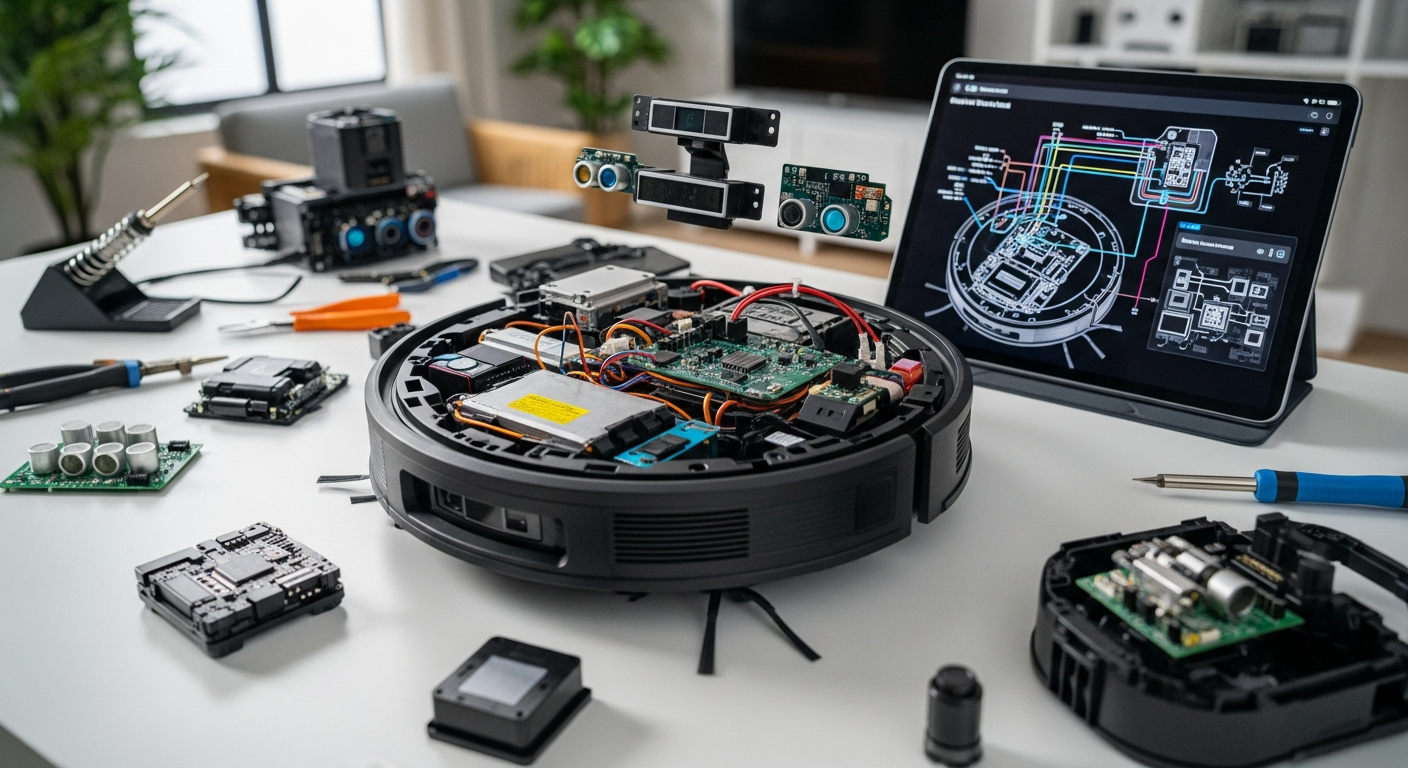
The magic of modern object avoidance comes from combining two types of sensors:
- RGB Camera: This is a standard color camera, just like in your phone. It feeds video to the on-board NPU, which runs an object recognition model trained to identify common household obstacles. It knows what a shoe looks like, what a power cord looks like, and (critically) what pet waste looks like.
- 3D Structured Light: This is the same technology used in facial recognition systems like Apple’s Face ID. The robot projects a pattern of invisible infrared dots into the room and uses a separate IR camera to measure how that pattern is distorted by objects. This allows it to build a real-time 3D depth map of its immediate surroundings, enabling it to perceive the shape and volume of an object, not just its 2D image.
This combination is powerful. The RGB camera says, “I see a long, thin object,” and the 3D sensor says, “and it’s only 5mm tall.” The robot’s logic concludes, “That’s a cable, I will navigate around it.”
Limitations: This system isn’t perfect.
* Mirrors & Reflective Surfaces: LiDAR and structured light can be confused by mirrors, sometimes causing the robot to think there’s another room or get its location wrong.
* Black Objects: Dark, non-reflective objects (like some black furniture legs or black socks on a dark rug) can absorb the infrared light, making them difficult for the 3D sensor to “see.”
* Glass: Transparent or semi-transparent objects like glass doors or table legs can be tricky for both sensor types.
Mechanical Innovation: The Rise of the Arms
For a decade, the biggest complaint about round robot vacuums has been their inability to clean edges and corners. The new flagship solution is refreshingly physical: robotic arms.
- Roborock’s FlexiArm: A small robotic arm extends the side brush out from the robot’s body, allowing it to flick debris out from under cabinet edges and along baseboards, pulling it into the path of the main roller.
- Dreame’s MopExtend: This is even more ambitious. An arm extends one of the circular mopping pads outwards, allowing it to physically scrub right up to the edge of the floor.
This is the kind of practical, effective engineering I love to see. It acknowledges the physical limitations of a round chassis and solves the problem with more robotics, not just another software patch.
The Walled Garden Problem & The Promise of Matter
This is where my enthusiasm gets tempered. For all their advanced hardware, these robots are still fundamentally locked into proprietary ecosystems. You must use the manufacturer’s app, which means you must have a cloud account, and your robot must be connected to their servers.
This presents several major problems:
* Privacy Risks: Your home’s floor plan, and in the case of vision-based robots, images from inside your house, are being sent to a third-party server. While companies promise security, data breaches happen.
* Cloud Dependency: If your internet goes down, or their servers go down, your robot’s advanced features might stop working.
* Vendor Lock-in & E-Waste: If the company goes out of business (as seen with the shutdown of Neato Robotics) or decides to end support for your model, your $1800 robot could become a paperweight.
Smart Home Integration Score:
* Roborock S8 MaxV Ultra: B+ (The “+” is for the future promise of Matter)
* Dreame L20 Ultra: C
* Shark AI Ultra: D
Privacy/Local Control Assessment:
* Roborock S8 MaxV Ultra: Good. The move to join the Connectivity Standards Alliance (CSA) and support Matter is the single most important development in this space. Matter is a local control protocol. Once fully implemented, it should allow devices like Home Assistant to control the robot directly over your Wi-Fi, no cloud required.
* Dreame L20 Ultra: Poor. Relies entirely on a proprietary cloud API. While there are some community-hacked integrations for Home Assistant, they are fragile and can break with any app update.
* Shark AI Ultra: Very Poor. Completely locked down. No public API, no community support. You use their app, or you have a dumb robot.
The Home Assistant Dream: Local Control YAML
Imagine a world where your robot is just another entity in Home Assistant, fully controllable with local automations. With Matter, or a proper local API, this is what it could look like:
This simple example shows the power of local control. The cleaning starts based on presence detection within my own system, and if it finds an obstacle, it can send a notification directly to my phone without ever sending that image to a Roborock server. This is the private, interoperable smart home we should be building.
Pros and Cons of 2024 Flagship Robot Vacuums
Pros
- Legitimate Object Avoidance: The combination of RGB cameras and 3D structured light finally delivers on the promise of avoiding common household clutter like cables and shoes.
- On-Device AI Processing: Critical navigation and object recognition decisions are made locally on the device, increasing speed and privacy.
- Innovative Edge Cleaning: Mechanical arms that extend brushes and mops are a brilliant physical solution to a long-standing problem.
- The Dawn of Local Control: Support for the Matter protocol by brands like Roborock signals a move away from vendor-locked cloud ecosystems.
Cons
- Exorbitant Cost: Flagship models are approaching the $2,000 mark, making them a significant luxury purchase.
- Zero Repairability: The lack of available spare parts or service manuals means a single component failure outside of warranty can turn the entire system into e-waste.
- Persistent Cloud Dependency: Most brands still require a cloud connection and proprietary app, posing privacy and longevity risks.
- Bulky Docking Stations: The all-in-one docks that wash, dry, and empty are massive and require regular maintenance of their own.
The Verdict: Is the New “AI” Worth the Price?
The advanced robot vacuum object avoidance in flagship models is not a gimmick; it’s a legitimate technological leap that solves the most frustrating problems of older robots. However, the decision to buy comes down to weighing that convenience against significant drawbacks.
- For the Tech Enthusiast & Home Automator: Yes, the Roborock S8 MaxV Ultra is the one to watch. Its combination of best-in-class object avoidance, mechanical engineering, and—most importantly—commitment to the Matter protocol makes it the clear choice for anyone building a future-proof, private smart home.
- For the Average Consumer: The price is a major hurdle. If you don’t need perfect edge mopping and are willing to do a quick “clutter pickup” before cleaning, a mid-range LiDAR model from a few years ago can offer 80% of the navigation performance for less than 40% of the price.
- The Bottom Line: The “AI” is real and it works. The mechanical arms are brilliant. But the industry’s universal failure on repairability and the slow adoption of local control protocols mean you are paying a premium for a device that is still, fundamentally, a disposable product tied to a corporate server. Choose wisely.
FAQ: Integration & Control
1. Can I block this from the internet and still use it?
For the Dreame and Shark, no. They require a cloud connection for full functionality. For the Roborock, once Matter support is fully rolled out, the answer should be yes. You’ll be able to set it up and then block its internet access at your router, controlling it locally via a Matter controller like Home Assistant.
2. Does it work with Home Assistant?
Yes, but with caveats. There are community-built “hacs” integrations for both Roborock and Dreame that work by reverse-engineering their cloud APIs. They are often excellent but can be unstable and break when the manufacturer updates their app. True, stable, local integration will only come with Matter.
3. What happens if the company shuts down?
This is the million-dollar question. As we saw with Neato, if the cloud servers that run the app are turned off, your robot loses all of its smart functionality. It becomes a “dumb” bump-and-go robot at best. This is the strongest argument for demanding local control protocols like Matter.
4. Is the ‘AI’ object avoidance just a gimmick?
No, it’s a legitimate and game-changing feature. The RGB + 3D Structured Light systems on the Roborock and Dreame are highly effective at preventing the most common types of failures (getting stuck on cables, shoes, etc.). It’s not perfect, but it’s a massive leap over older systems and is the main reason these flagships command such a high price.
5. Is Matter support a real game-changer?
Absolutely. It’s the most significant development for smart home privacy and interoperability in years. For a device class plagued by walled gardens and cloud dependency, Matter offers a path to a future where we truly own and control our devices. Companies like Roborock that are embracing it deserve our support.