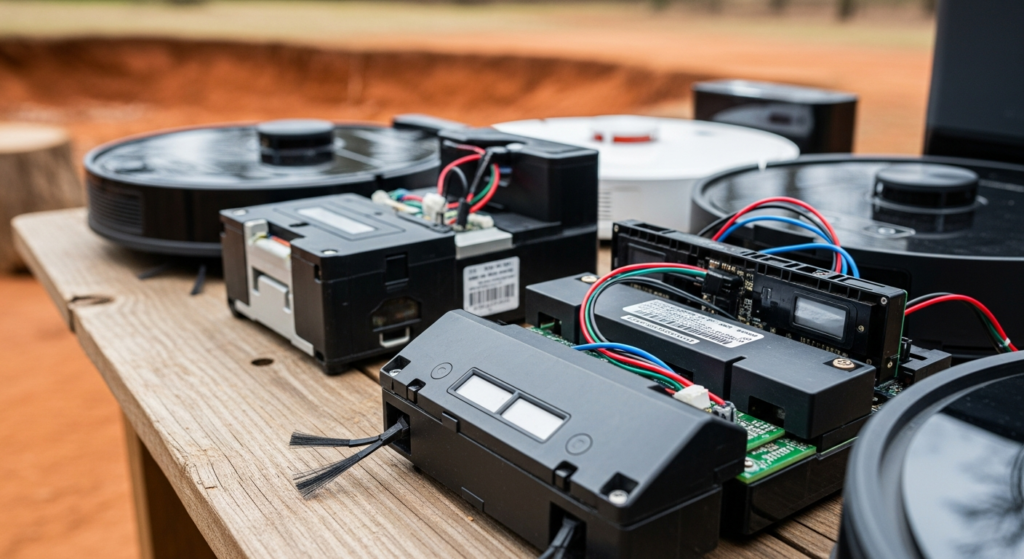
You have a problem. Your floors are dirty, but the promise of an automated cleaning robot feels like a trap. You’re caught between buying a “dumb” bot that pinballs around your living room or a “smart” one that maps your home only to send that data to a server in a country you can’t pronounce. The marketing is a firehose of buzzwords like “AI Navigation,” but what does that mean at the hardware level?
This isn’t another surface-level review. This is a hardware audit. We’re tearing these machines down—conceptually and literally—to see what makes them tick. This robot vacuum hardware comparison will answer the ‘Brain Check’ question: Does it think for itself on your local network, or is it just a remote-controlled drone for a corporate cloud? For a deeper dive into the AI models themselves, check out our Robot Vacuum AI Review: Local vs. Cloud [2026].
The Great Divide: LiDAR vs. vSLAM (Camera) Hardware
Forget the brand names for a second. A robot vacuum’s intelligence is defined almost entirely by its primary navigation sensor. Everything else—the cleaning performance, the efficiency, the privacy implications—stems from this single hardware choice. There are two main camps.
The LiDAR Camp: Geometric Precision
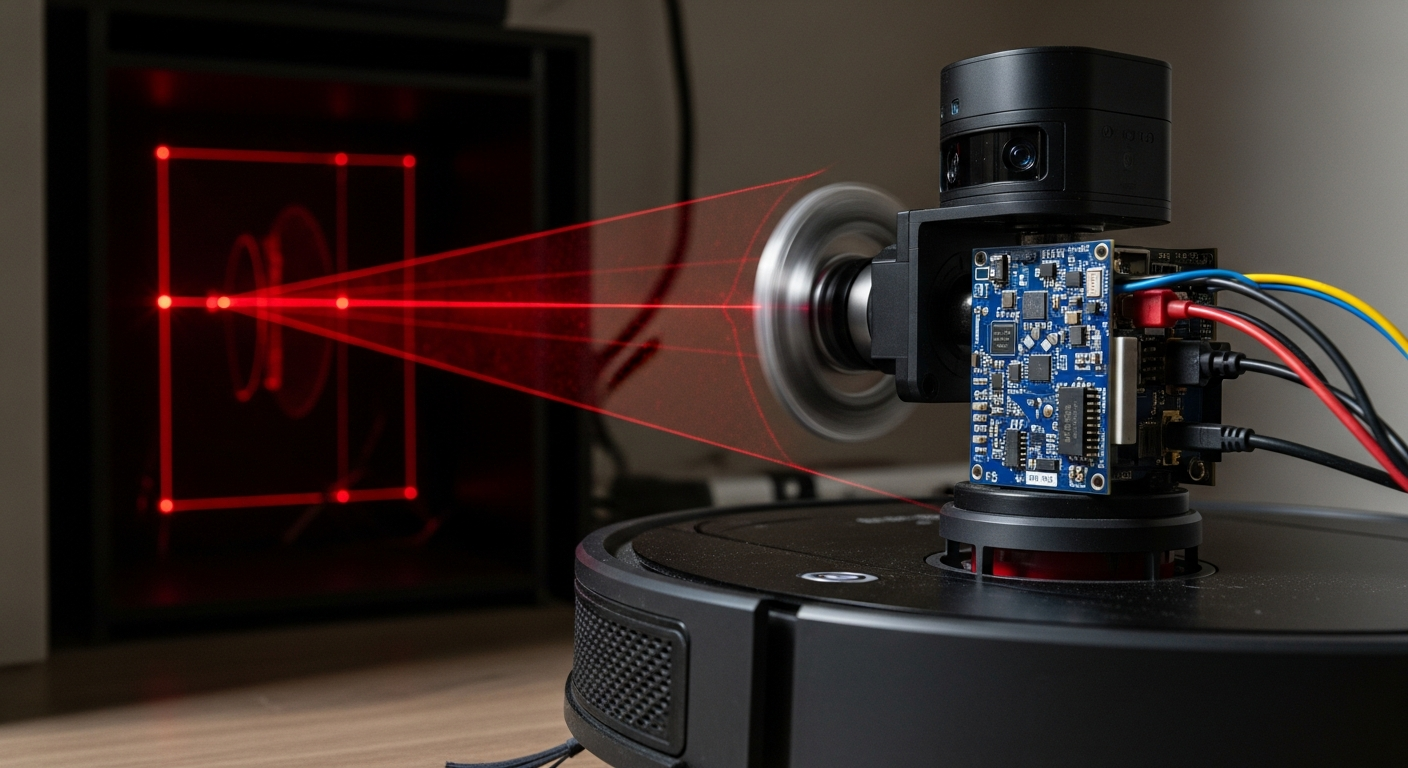
LiDAR (Light Detection and Ranging) is the gold standard for mapping. A spinning turret on top of the robot shoots out a low-power laser, measuring the time it takes for the light to reflect off surfaces. It does this hundreds or thousands of times per second, building an incredibly precise, 2D point-cloud map of your home. This approach is a practical application of SLAM algorithms extensively studied by institutions like IEEE.
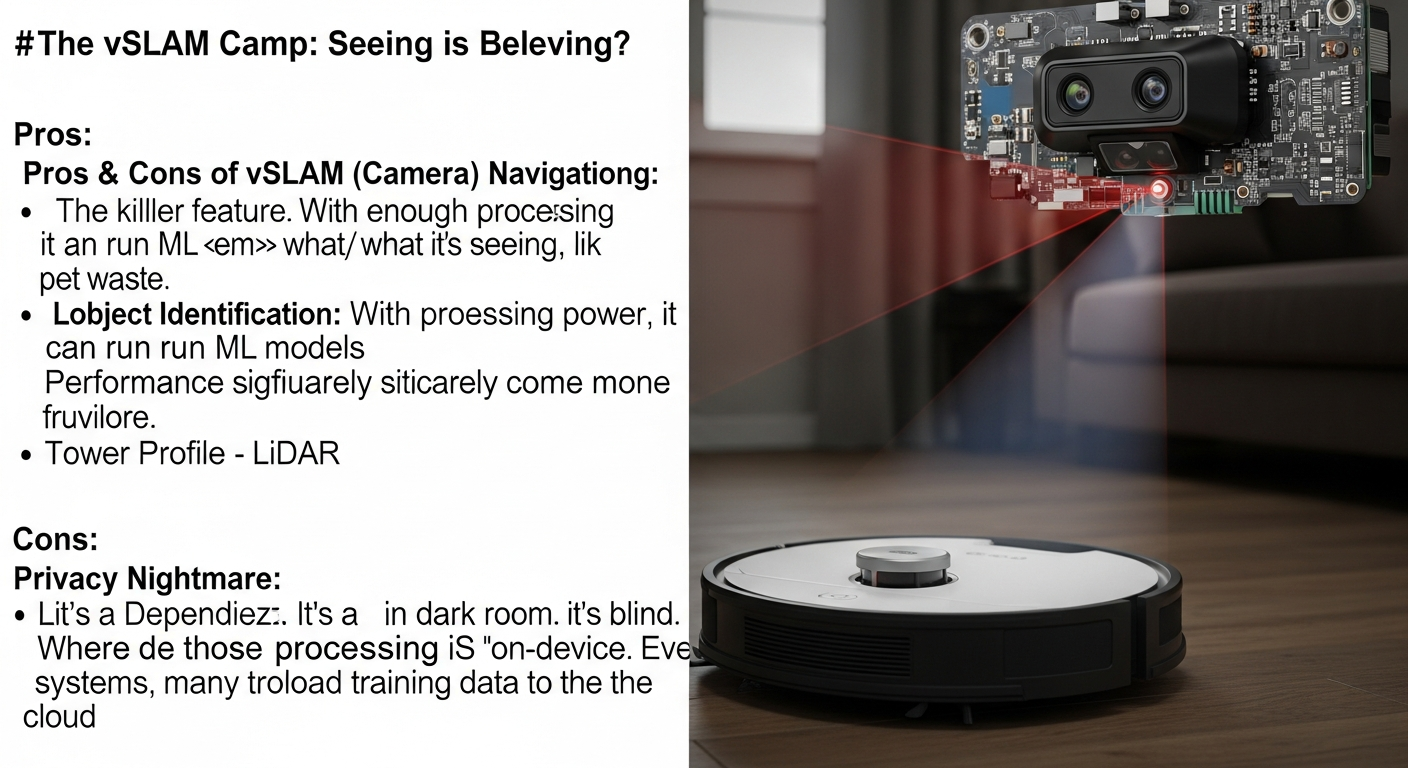
The vSLAM Camp: Seeing is Believing?
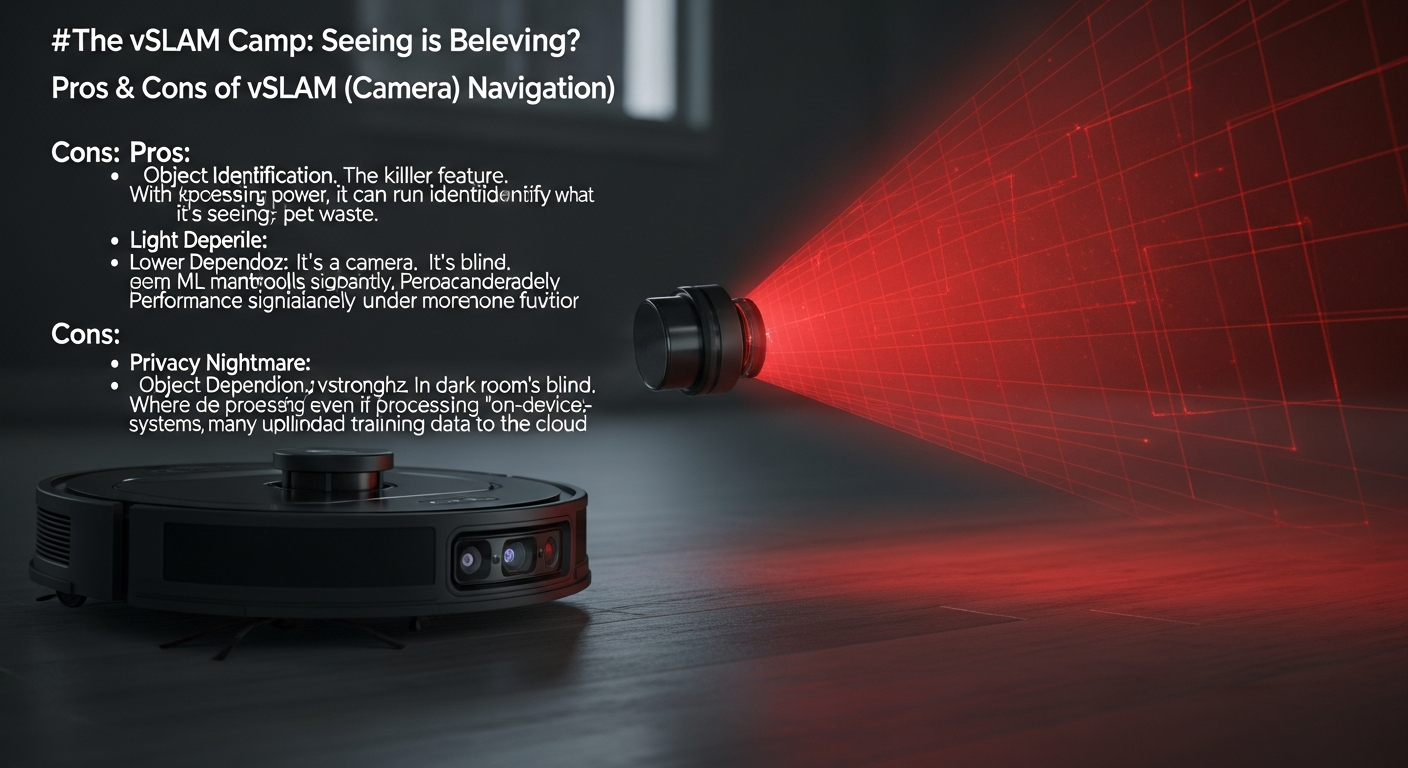
Visual Simultaneous Localization and Mapping (vSLAM) uses a camera—typically a wide-angle lens—to navigate. It identifies unique features in your home (the corner of a picture frame, the leg of a table) and uses them as landmarks to build a map and determine its position.
Hardware Teardown: Spec Sheet Showdown
Manufacturers are notoriously opaque about the actual compute hardware inside these things. They prefer marketing fluff over listing CPU cores or RAM amounts. This table cuts through the noise, focusing on what matters for performance and local control.
Verdict: Key Takeaways for Your Purchase
Choosing the right robot vacuum hardware comes down to your priorities. Here is our final analysis:
- For Ultimate Privacy & Control: A LiDAR-based Roborock model capable of running Valetudo is the undisputed champion. You get excellent navigation with zero cloud dependency.
- For Best “Fire-and-Forget” Obstacle Avoidance: The iRobot Roomba j7’s camera-based object recognition is currently best-in-class for avoiding tricky items like pet waste and cables, but it comes at the cost of privacy and local control.
- Best Value Hardware: LiDAR is no longer a premium-only feature. Models from Wyze prove the core mapping tech is affordable, though they often sacrifice local control and advanced object avoidance.
- The Future is Local: Do not buy a robot based on a future promise of Matter support. Wait until the hardware is released with Matter integrated from the factory. True local control is the next major battleground.
The Integration & Local Control Scorecard
This is the most critical test. A robot vacuum that requires the cloud to function is a liability, not an asset.
Smart Home Integration Score:
- Roborock (with Valetudo): 9/10. Once rooted and running Valetudo, it’s a dream. Full local control via MQTT. The de-facto standard for tinkerers.
- iRobot: 3/10. The official Home Assistant integration is a cloud-polling mess. It breaks if your internet is down or iRobot’s servers have a bad day.
- Wyze/Ecovacs/Dreame: 2/10. Locked-down ecosystems. You’re using their app, and that’s it.
Privacy/Local Control Assessment:
- The Walled Garden (iRobot, Ecovacs, etc.): You get advanced features, but the cost is privacy. You must trust the company’s privacy policy. Verdict: FAIL.
- The Open Pasture (Rootable Roborock): By flashing open-source firmware like Valetudo, you sever the cloud connection permanently. All processing and control happens on your local network. Verdict: PASS.
Hacking for Local Control: Home Assistant + Valetudo
If you’ve rooted your Roborock with Valetudo, integrating it into Home Assistant is trivial. The robot is exposed as an MQTT device, giving you full local control. You’ll need a hub to run Home Assistant, of course; see our guide on Home Assistant Green vs. Yellow to pick the right hardware.
Here’s a sample of what your configuration.yaml might look like, following the official Home Assistant MQTT vacuum documentation.
With this, you can start/stop cleans and set fan speed, all without a single packet leaving your home network.
The Future: Matter, On-Device LLMs, and Repairability
- Matter: The smart home standard now includes robot vacuums, promising a standardized, local method of control. However, no current models support it out of the box. This is the holy grail, but we are a generation of hardware away. For now, you can read about The Matter Smart Home Standard: A Real-World Test of Local Control to understand its potential.
- On-Device AI: The next step is running more complex models, potentially small language models (SLMs), on the device itself. This requires more powerful NPUs (Neural Processing Units) and is the next major hardware battleground.
- Repairability: The ability to buy replacement batteries, wheels, and brushes is critical. Brands like Roborock have a healthy third-party parts market. iRobot is more locked down. Before you buy, search for “[Robot Model] replacement battery” and see what’s available.
FAQ: Integration & Control
1. Can I block this robot vacuum from the internet?
Yes. You can use your router’s firewall to block its MAC address from accessing the internet. For cloud-dependent bots (iRobot, Ecovacs), this will break the app. For a Valetudo-flashed robot, it will continue to work perfectly on your local network.
2. Does it work with Home Assistant?
Most do, but the quality of the integration varies wildly. Rootable Roborock bots with Valetudo offer a first-class, local MQTT integration. Others rely on brittle, reverse-engineered cloud integrations.
3. What is Valetudo and should I install it?
Valetudo is open-source firmware that replaces cloud-connectivity on certain robot vacuums (primarily Roborock/Dreame models). It provides a web interface and MQTT for full local control. If you value privacy and local control, the answer is an unequivocal yes.
4. Is a camera-based robot a privacy risk?
Potentially, yes. It is a network-connected camera on your floor. While companies claim processing is on-device, many have data-sharing options that send images from your home to their servers. A LiDAR-only robot cannot capture images, eliminating this risk.
5. Will my robot vacuum support Matter?
Unlikely for existing models. True, reliable Matter support will likely require purchasing new hardware specifically built for the standard. Treat any current “Matter-ready” claims with extreme skepticism.